
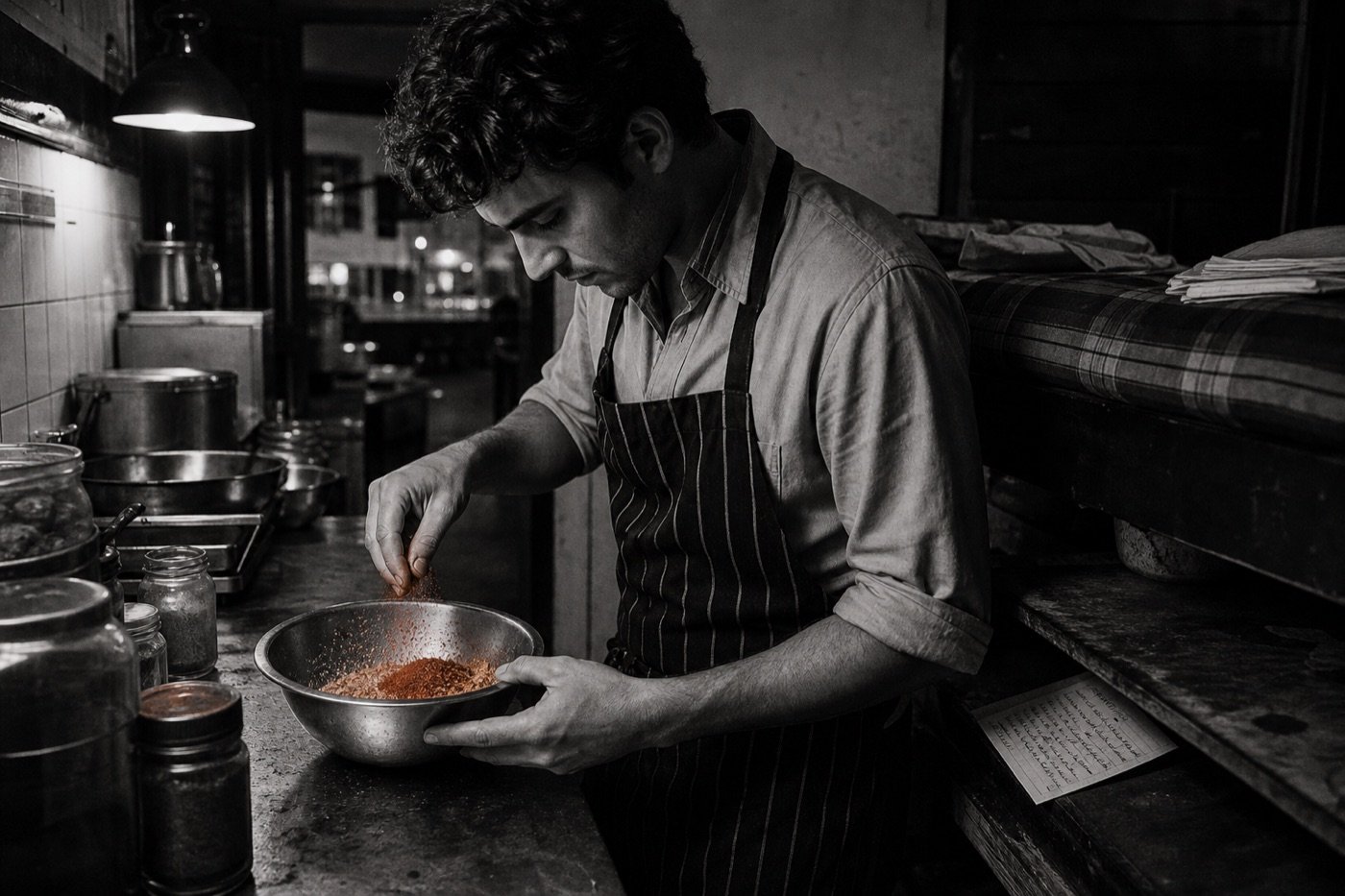
Sometime in 1972, in Waco, Texas, a young South African named George Sombonos ate the best fried chicken of his life and decided he had to have the recipe.
The owner eventually agreed to sell it. The price was $5,000. Sombonos had $1,000 in traveller’s cheques. So he did not get the recipe he wanted. He got a different one, an untested one the owner was willing to part with for the money he actually had. By his own account, it was a leap into the dark. For all he knew, he had just paid $1,000 for a mix of salt and pepper.
He carried it home to Johannesburg, mixed up a batch of the coating in secret, and hid it under his bed. Then, without telling his father, he swapped it into the recipe at the family roadhouse.
It worked. Over the next four years, turnover at that roadhouse grew from R25,000 a month to R200,000. The untested gamble had paid off, and the foundation of what would become the largest non-American-owned fried chicken chain in the world had been laid by a man who could not afford the thing he actually went to buy.
That is the story everyone tells about Chicken Licken. It is a good story. But it is not the reason the business became what it became. The recipe got him started. What made him rich was a set of decisions about what to own, and what to let other people own instead.
An apprenticeship of hell
Sombonos was the son of a Greek immigrant who came to South Africa during the Second World War and opened a roadhouse called the Dairy Den in Ridgeway, on the south side of Johannesburg. George was born in 1949, and he grew up in the business in the most literal sense. He was serving customers on Saturdays by the age of seven. By eleven, as he liked to tell it, he knew the difference between a close corporation and a private company, and he knew not to answer the phone when the bank manager was calling.
He later called it an apprenticeship of hell. After he matriculated in 1966 he worked full-time at the Dairy Den, and when his father had a heart attack, Sombonos, then twenty-three, found himself running the whole thing alone.
The American trips were his father’s idea of research, and they were as strict as everything else about the man. Once a year, Sombonos remembered, his father would throw an airline ticket across the dinner table and tell him to go to America. So he went, and he ate. He would pick a fast-food strip and work his way down it, eating twenty pieces of chicken from different outlets one day and a dozen hamburgers the next, until he made himself ill. That was the discipline that took him to Waco. He was not sightseeing. He was hunting for something worth bringing home.
He wanted it badly enough to lose his father over it
The recipe changed the roadhouse, but it did not make it his. The Dairy Den still belonged to his father, and that became a problem, because Sombonos could see what he had built and he wanted a share of it. When he asked his father for five percent of the profits, he was turned down flat, and his father threatened to replace him with a cousin from Bloemfontein.
So he waited, and when his father went to Greece on holiday around 1980, Sombonos moved. He changed the lease on the property into his own name while his father was away. When his father found out, he did not speak to his son for three months. They reconciled only shortly before the older man died.
It is an uncomfortable story, and Sombonos never really softened it. He explained it in terms that sound extreme until you have met enough founders. He wanted that shop so badly, he said, that he was prepared to die for it, and he believed that this was the difference between an ordinary person and an entrepreneur, that you want something so badly you would do almost anything for it. He said he had been afraid people would think he was mad, until he came across a line attributed to Martin Luther King, that if you have not found something worth dying for, you are not fit to live.
Hold that thought, because the obsession is not a side note. It is the engine.
Chicken Licken, for R375
On 1 January 1981, the Dairy Den signs came down and the business became his own. His first choice of name was Golden Fried Chicken, which turned out to be a problem, because it was too descriptive to protect as a trademark. Then one of his waiters suggested a name from a children’s story, the tale of Chicken Licken. Sombonos loved it. He gave the waiter R300 and a nursery book as thanks, paid a sign painter R75 for a chicken-head logo, and for R375 he had a name and an identity that are still on the buildings today.
The lesson was cheap and permanent. A good, protectable brand did not require a fortune. It required the right idea and the sense to recognise it when a waiter handed it to you.
He built where the giants would not go
Here is the part that gets lost in the fondness for the jingle. Sombonos built Chicken Licken by serving the customers that the global chains, in apartheid South Africa, were largely not serving.
KFC had entered the South African market in 1971, a decade before Chicken Licken existed, with all the advantages of an American giant. But the country it operated in was legally segregated. As early as 1975, at the Dairy Den, Sombonos had started serving black customers in their cars, because the law restricted their access to restaurants. When he began franchising Chicken Licken, he went straight into the townships, into Soweto and Alexandra, into a market the incumbents treated as marginal and difficult and not worth the trouble.
That was the whole opening. He took an ordinary product, fried chicken, to an enormous customer base that the established players had effectively written off, and he became their brand first. It is the same move you see again and again in this series. The opportunity was not a better chicken. The opportunity was a market everyone else had decided to ignore.
It was not smooth. The townships through the 1980s were a place of real political turmoil, and Sombonos remembered it as a very bad time to be trying to run and supply a growing chain. His chicken supplier, Rainbow, reportedly dismissed him early on as a Mickey Mouse operation, and then had to scramble when his sales took off. At peak demand he was importing chicken from Brazil to keep the stores stocked. None of it was tidy. All of it was in a market the giants were not fighting him for.
The R10,000 in a chicken packet
The giants did notice eventually. In 1982, after Sombonos had opened franchises in Soweto and Alexandra, KFC took him to court, arguing that the name Chicken Licken was too close to its own “finger lickin’ good” line.
The way Sombonos told the story, his lawyers said fighting it would cost R10,000. He did not have R10,000. So he borrowed it from his mother, finished his shift, and drove to Pretoria with the cash in a Chicken Licken packet. The office was almost empty. Not wanting to hand a fortune to a receptionist he did not know, he told her he had ten pieces of chicken for the bosses and left. She reportedly put the packet in the fridge. The next morning he phoned to make sure the money had been found.
He won. In his own words, after that, the highway was open. A one-man operation, run by a man who hid the fact by pretending to be his own marketing manager and his own accountant on the phone, had beaten an American multinational in court and kept its name.
What he chose to own
Now the real strategy, the part worth studying.
Sombonos did not try to build and own hundreds of restaurants himself. He franchised, aggressively and deliberately. He gave away his first two franchises, in Zola in Soweto and in Alexandra, for nothing, simply to get the model moving and prove it worked. When he started selling franchises in 1985, he priced them at R3,000, threw in around R15,000 of equipment and stock, and took no royalties for the first four months. He made very little money in the early going, and by his own account he did not care, because the store count was climbing and that was the point.
He kept almost none of the outlets for the company. By 2013, of well over 200 Chicken Licken stores, only around a dozen were company-owned. He said openly that he did not believe in a model where the company owned too many of its own restaurants, an approach he had first admired watching Subway in the United States.
Sit with what that means. Sombonos owned the two things that copy for free and scale without limit, the recipe and the brand. He let his franchisees own the two things that are expensive and carry all the risk, the physical stores and the capital tied up in them. Every new outlet was somebody else’s money, somebody else’s lease, somebody else’s long hours, all selling his chicken under his name. He built the largest non-American fried chicken chain on earth while keeping his own balance sheet remarkably light.
That is not a detail. That is the business.
The jingle that did the rest
If the recipe was the product and the franchise model was the distribution, the marketing was the multiplier, and this is where Chicken Licken became a genuine piece of South African culture rather than just a place to eat.
Around the mid-1980s, Sombonos brought in an ad agency, which suggested using the actor Joe Mafela, then well known from a popular television comedy. There was no budget for a studio, so they filmed in the Booysens outlet, and there was no music. The story goes that after a few drinks Mafela started playing around on a piano and improvised what became one of the most recognisable jingles in the country: “It’s good, good, good, it’s good, it’s nice.” When the campaign built around it ran, sales jumped by around 47 percent. Sombonos described the response as wildfire.
He had done market research the way his father taught him, by getting on a plane to America every few years and paying attention, rather than by paying a research firm. The instinct behind that jingle, and the run of cheeky, distinctly local advertising that followed it, is a large part of why the brand still feels like it belongs to the country rather than to a boardroom.
The uncomfortable part of the legacy
It would be dishonest to leave it there, so here is the part that complicates the underdog story.
The company that beat a multinational over the right to its own name later became the one doing the suing. In 1994, Chicken Licken trademarked the word “soul,” and over the years it has pursued a long list of far smaller businesses that used the word, including a Durban vegan restaurant called Oh My Soul, which it took to court in 2019. That case, at least, it lost, with the judge ruling against the chain. It is a strange echo. The scrappy challenger who borrowed R10,000 from his mother to defend his name grew into a R3 billion corporate willing to lean hard on operators a fraction of its size. Both things are true, and a good founder story should be able to hold both.
Where the highway led
George Sombonos died in 2016, at sixty-seven, after a battle with cancer. The business he left behind now runs somewhere around 286 outlets and turns over in the region of R3 billion a year, and it remains the largest non-American-owned fried chicken franchise in the world.
His daughter, Chantal Sombonos-Van Tonder, whom he had groomed for years, runs it now, and under her the brand has become one of the most awarded advertisers in the country, with a shelf full of Loeries to show for it. She has said her father told her that if you believe in something, you should be willing to die for it. It is the same line he used about that first shop, the one he changed the lease on while his father was in Greece. He passed the obsession down along with the recipe.
Where I land on this
The detail I keep coming back to is not the recipe under the bed, dramatic as it is. It is the dozen company-owned stores out of hundreds.
Sombonos understood something that took me years to properly grasp in my own work. He separated the assets that scale for free from the assets that cost you every time. A recipe can be copied into a thousand kitchens at no extra cost. A brand gets more valuable the more places it appears. But a store costs real money, carries real risk, and ties up capital that then cannot do anything else. So he held on tightly to the first kind and gave away the second kind, and he let hundreds of other people fund his growth and take his risk while he kept the parts that multiplied.
For anyone building something small, that is the question worth sitting with. What do you actually own that scales without draining you, and what are you clinging to that just costs you money and time every time it grows. Sombonos would have told you to keep the recipe and the name, and let somebody else buy the fryer.
The other thing I take from him is less comfortable, and I hold it more loosely, because obsession is a double-edged thing. He wanted it so badly he lost his father for three months over a lease. That same drive built an empire and, later, turned into a company that squeezed businesses smaller than a rounding error over a single word. The hunger that makes a founder is not automatically a virtue. It is a force, and it goes wherever you point it.
He went to America with an airline ticket thrown across a dinner table, and he came home with a thousand-dollar bet hidden under his bed. Everything else, the townships, the court fight, the jingle, the franchises, was just him refusing, again and again, to let anyone tell him the thing he wanted was not worth having.
That is the recipe that was never for sale.
Sources
- Sunday Times, “Obituary: George Sombonos, chicken king who served across the colour bar” (4 December 2016). The Waco recipe and the $5,000-versus-$1,000 detail, the coating hidden under the bed, the R25,000-to-R200,000 turnover growth, the KFC case, the one-man-operation ruses, and his family and death. https://www.sundaytimes.timeslive.co.za/sunday-times/opinion-and-analysis/2016-12-04-obituary-george-sombonos-chicken-king-who-served-across-the-colour-bar/
- BusinessTech, “The man who built South Africa’s largest fried chicken takeaway restaurant chain” (16 February 2025). The airline-ticket detail, the $1,000 recipe, the R300-and-R75 naming story, the R10,000-in-a-Chicken-Licken-packet account, and the early free franchises. https://businesstech.co.za/news/business/812049/the-man-who-built-south-africas-largest-fried-chicken-takeaway-restaurant-chain/
- ExpertHub, “Chicken Licken: George Sombonos.” Long first-person profile: the eating tours, the “prepared to die for it” quote, the lease change and the three-month estrangement, the franchising origins, and the Joe Mafela campaign with the 47 percent sales jump. https://www.experthub.info/success/success-stories/chicken-licken-george-sombonos/
- Daily Investor, “The man behind Chicken Licken” (30 July 2024). Early life, the recipe, the KFC case, the post-1994 move into suburbs and malls, the “soul” trademark, and daughter Chantal’s tenure and accolades. https://dailyinvestor.com/business/59253/the-man-behind-chicken-licken/
- SA Franchise Brands, “The Man Behind Chicken Licken” (27 August 2024). The 286-outlet figure and the largest-non-American fried chicken brand claim. https://www.safranchisebrands.co.za/article/the-man-behind-chicken-licken/
- Wikipedia, “Chicken Licken (restaurant).” KFC’s 1971 South African entry, serving black customers in cars from 1975, the 1976 drive-through, the franchise-light ownership structure, the Joe Mafela jingle, and the “soul” trademark enforcement including the 2019 Oh My Soul case. https://en.wikipedia.org/wiki/Chicken_licken_restaurant
- Living in SA, “The Rise and Success of Chicken Licken” (24 April 2023). The 5 percent profit request and the cousin-from-Bloemfontein threat, the free early franchises and the R3,000 franchise fee, and the Rainbow Chicken and Brazil-import detail. https://livinginsatv.com/2023/04/24/the-rise-success-of-chicken-licken/